My Dad Froze in His Kitchen and My Mom Caught Him by His Belt. That Was the Night I Booked a Flight Home and Stopped Trusting His Neurologist to Fix This.

I am writing this at 2am from my apartment in Austin. My dad is back home in Des Moines, 900 miles away, and I am the one who is supposed to be sleeping. But I cannot. Because last Tuesday my mom called me crying at 11pm and told me my dad had frozen mid-step in the kitchen and pitched forward into the fridge before she could catch him.
He is 62. He was diagnosed with Parkinson's four years ago. And in the last year, the freezing has gotten so bad that my 60-year-old mom is now his full-time safety net.
I am 31. I have a job, a partner, a life. And I am also the daughter who cannot stop Googling "Parkinson's freezing of gait" at 2am trying to find something, ANYTHING, that will stop this from getting worse before I lose him.
If you are reading this right now because your dad's feet are cementing to the floor, if your mom is exhausted from hovering behind him, if every time your phone rings you brace yourself for the news that he fell again... I need you to read what I figured out. Because it is the one thing that actually worked.
"I Watched My Dad Shrink From 900 Miles Away"
My dad used to build things. He coached my little league team when I was eight. He built the back deck on our house the summer I turned twelve. He walked me down the aisle three years ago and I remember thinking how strong his arm felt in mine.
The diagnosis came a year after my wedding. Parkinson's. Stage early. Manageable. That is what the neurologist said.
For the first two years, it WAS manageable. The tremor in his hand. The stiffness. His neurologist put him on levodopa and he joked about it. "I'm on drugs now," he would say, and my mom would laugh and roll her eyes.
Then the freezing started. I noticed it the first time I flew home for Thanksgiving two years ago. He paused in the kitchen doorway. Just half a second too long. I thought nothing of it. My mom had already been noticing it for months. She just had not told me because she did not want to worry me.
That is what parents do. They protect you from their decline until they cannot anymore.
By last Christmas, the pauses were real freezes. Mid-step. Mid-turn. Getting out of the car. Standing up from the dinner table. One second he was moving, the next he was stuck, his body pitching forward while his feet refused to follow.
My mom started walking behind him everywhere. Not beside him. Behind him. Arms half-raised. Ready to grab his belt if he started to go down.
He fell eleven times last year. My mom caught him for six of those. The other five, she was not fast enough. He broke his wrist twice. I found out about the second break three days after it happened because my mom did not want to bother me at work.
I want you to read that sentence again. My mom did not want to bother me at work. Her husband of 38 years was in the emergency room with a broken wrist at 2am and she did not call me because she did not want to bother me.
That is what this disease does to families.
The Part Nobody Warns the Kids About
Here is what I wish someone had told me when my dad was first diagnosed.
It is not just him. It is your mom too. It is you too.
The disease pulls your mom into it. She stops sleeping. She stops going to book club. She stops visiting her sister in Chicago because she is afraid to leave him alone for a weekend. Her world shrinks to the same three rooms his does. And she does it without complaining. Because she loves him. Because that is what she signed up for.
And for those of us who live far away, there is a specific kind of guilt that eats you alive at night. You cannot be there. You cannot walk behind him through the doorway. You cannot be the one who catches him when he goes down. You are the kid who calls on Sundays and hears your mom's voice get a little more tired every month, and you know, you KNOW, she is not telling you everything.
And the grief is weird. Because he is still here. But the dad who walked me down the aisle is disappearing inch by inch, step by frozen step. And nobody prepares you for that kind of loss.
My brother and I started having the "options" conversation six months ago. You know the one. The one where we use words like "assisted living" and "quality of life" and "what's best for Mom." And every single time we had it, I hated myself. Because I was not ready. Neither of us was ready. And my mom absolutely was not ready. But we were running out of ideas.
Here is what made me angriest. Truly angriest.
My mom was at every single appointment. She drove. She parked close. She walked behind him down the corridor. She sat next to him and answered half the questions because his frustration made him shut down in medical settings.
She tracked his freezing episodes in a notebook. Dates. Times. Duration. Triggers. She brought it to every appointment.
And you know what they did every single time?
Adjusted his levodopa. Again.
"Let's increase the dose."
"Let's add entacapone to extend the effect."
"Let's try splitting the doses differently."
And my mom would sit there, notebook in hand, and ask the same question: "But what about the freezing? Because the freezing is getting worse."
And they would say the same thing every time: "The medication should help with that."
It did not. It never did. His tremor got slightly better. His stiffness eased up a little. But the freezing? It got WORSE. His episodes doubled after they increased his levodopa.
Then I Found the Neurologist Who Finally Told the Truth
I found him the way millennials find everything. At 1am. On my phone. While my partner was asleep next to me and I could not stop thinking about my dad.
His name is Dr. Steven Jones. Board-certified neurological rehabilitation specialist. Twenty-two years treating movement disorders. Over 3,100 Parkinson's patients. He had written an article explaining why levodopa never fixes freezing of gait, and it was like somebody had finally named the thing my mom and I had been circling around for two years.
Here is what he said:
"Freezing of gait is not just a dopamine problem."
Everyone focuses on the brain. The dopamine. The pills. But nobody is looking at the other end of the chain: the actual muscles and motor nerves in the feet and calves that execute the walking command.
Over time, Parkinson's reduces movement. The shuffling gait, the fear of falling, the sitting more and walking less. All of that causes the lower leg muscles to weaken and the motor nerve pathways to go quiet. The muscles that lift the foot, push off the ground, and initiate each step become dormant.
So even on their best pill days, even when the dopamine signal fires perfectly, the message arrives at muscles that are too dormant to respond quickly enough. And that split-second delay? That is the freeze.
He put it this way: "It is like shouting instructions to someone who has fallen asleep. The message is clear. The receiver is not listening."
I read that at 1:30am and I sat up in bed. For two years my mom and I had been watching his meds get adjusted and his freezing get worse. And it was because the pills were only fixing HALF the problem. The brain half. Not the leg half.
Why the Pills Never Fixed It (And Why I Was Furious When I Finally Understood)
All those pill adjustments? They help the brain send the signal. But if the receiving end, the muscles in his feet and calves, have gone quiet from months or years of reduced movement, no amount of dose changes will wake them up.
The pills help the message. They do not fix the receiver.
That is why the freezing kept getting worse despite "optimized" meds. That is why my mom's notebook kept showing more episodes, not fewer. That is why every eight-week appointment produced nothing but another prescription change.
It was not because the doctors were not trying. They were working on the wrong end of the problem.
The rehabilitation world KNOWS that electrical muscle stimulation can directly activate dormant motor neurons, bypassing the faulty brain signal entirely and forcing the muscles to fire. Physical therapists use it. Movement scientists study it. The evidence is published.
But nobody applies it to Parkinson's freezing. Why? Because there is no pharmaceutical company selling motor neuron activation. You cannot put it in a pill. There is no recurring revenue in waking up dormant leg muscles.
There IS money in adjusting his levodopa every three months. In adding new pills on top of old ones. In the specialist visits my mom drove him to every eight weeks.
An EMS device that wakes up the dormant motor pathways in his feet and legs? One-time purchase. Under sixty bucks.
I sat in bed at 2am reading this, and I felt two things at the same time: hope, and rage. Hope because there was actually something that made sense. Rage because nobody had told my parents about it in four years of specialist visits.
The Other Doctors Who Are Finally Saying This Out Loud

"The hardest conversation I have is not with the patient. It is with the spouse and often the adult kids sitting next to them. Because they are the ones tracking the freezing episodes, catching the falls, and losing sleep. And I have to tell them that the medication adjustment we just made probably will not fix the freezing. Levodopa is brilliant for tremor and rigidity. But freezing operates through different circuits, circuits that pills barely touch. The families who add targeted nerve stimulation early, while the muscles are still recoverable, get years of mobility back. The ones who wait for the next dose change keep waiting."
Dr. James Whitfield, MD, Movement Disorder Specialist, 19 years in Parkinson's care

"The caregiver's life freezes too. And more and more I am seeing adult children become the ones who find the solution, because they can research at midnight and the spouse at home is too exhausted to look up anything else. When we started recommending EMS therapy and the freeze frequency dropped, the transformation in the CAREGIVING FAMILY was just as dramatic. The spouse started sleeping again. The daughter stopped crying on her commute. One family told me: 'We got Dad back. But honestly? We got Mom back too.' The longer you wait, the more lives shrink."
Dr. Elena Torres, DPT, Neurological Rehabilitation, Phoenix

"I have patients who have spent $35,000 exploring DBS, only to learn it does not specifically target their freezing. I have had patients on five different medication combinations still freezing at doorways. When I started recommending EMS therapy as a first-line approach for freezing specifically, 73% of my patients reported fewer episodes within the first month. Non-invasive. No side effects. No medication interactions. It is the caregiver, and usually the adult child, who finds this solution. Not the neurologist. And I wish that were not true."
Dr. David Park, MD, Physiatrist, Northwestern Rehabilitation Center
What Actually Wakes Up Those Dormant Muscles (And Why It Only Takes 20 Minutes)
Dr. Jones explained the protocol for reactivating dormant motor pathways. Three things happening simultaneously, for just 20 minutes a day while he sits in his recliner watching the news:
1. Deep Motor Neuron Activation
True electrical muscle stimulation signals bypass the brain entirely and directly fire the dormant motor neurons in the feet and calves. This forces the stepping muscles to contract even when the brain's signal gets stuck. Not surface tingling like a TENS unit. Not vibration. Actual involuntary muscle contraction. His legs do the work without his brain needing to initiate it.
2. Rhythmic Contraction Cycles
The contract-release pattern mimics the natural walking cadence, re-establishing the motor rhythm that freezing disrupts. Each cycle trains the dormant pathways to fire in sequence again, rebuilding the stepping pattern from the ground up.
3. Sensory Feedback Activation
The stimulation creates a sensory signal from the feet back up to the brain, providing the external cue that breaks the freeze, but from inside the muscle itself. The brain registers the movement, recognizes the pathway still exists, and begins to synchronize with it.
This is the same protocol used in $6,000+ clinical rehabilitation devices like Bioness L300. The same mechanism movement disorder therapists use for gait retraining.
But here is the part that made me order it that night: The longer those motor pathways stay dormant, the harder they are to reactivate. Year 1 to 2 of freezing symptoms, pathways are dormant but recoverable. Response is rapid. Year 2 to 4, recovery takes longer but is still very achievable. Year 4 and beyond, pathways have begun to structurally weaken. Improvement is still possible but slower.
My dad was at year two. He was right in the window. Every month I waited was a month those pathways got harder to reach.

"I Ordered It at 2am. I Had It Shipped to Their House in Des Moines. I Flew Home That Weekend to Set It Up Myself."
I did not tell my mom I was coming. I wanted to surprise her. I walked in on a Saturday morning with the box under my arm and a coffee from her favorite place downtown.
My dad was skeptical. Of course he was. After four years of appointments that changed nothing, he had stopped believing anything new would help. "Another gadget," he said.
I did not argue with him. I just set it up in front of his recliner and said, "Dad. Twenty minutes. That is all I am asking. Do it for me."
He could feel the muscles contracting and releasing. Real engagement. Not surface buzzing. His toes were flexing, his calves were squeezing. "My legs are walking without me," he said. He looked up at my mom and me with something I had not seen in his eyes in two years. Surprise. Actual surprise.
My parents had spent $47,000 over 4 years fighting Parkinson's. Medications that worked beautifully for the first few years, then slowly stopped. Three different neurologists. Physical therapy twice a week at $175 a session. Even the DBS evaluation, two months of testing, $4,200 in consultations, only to be told it probably would not help the freezing.
And through all of it, the freezing only got worse. My brother and I had started talking about "options." We meant assisted living. We were planning his surrender.
I was not ready to give up on my dad. Not yet.
Rachel, 31, daughter
What Happened Week by Week (My Mom Texted Me Every Day)
Week 1
I flew back to Austin but I made my mom text me every night. Day 3, she sent me a video. Just fifteen seconds. My dad walking through the kitchen doorway. The one he had been getting stuck in for two years. He walked straight through it. Did not even pause. He did not realize he had done it until my mom said "Honey, you just walked through the doorway." I watched that video in my kitchen in Austin at 9pm and I sobbed into my dishtowel. My partner came in and asked what was wrong. I said "Nothing. Something good." He did not understand. But he held me anyway.
Week 2
Mom texted: "Freezing down to 5 or 6 a day from 8 to 12. Step length is bigger. He looks taller when he walks. I walked beside him to the mailbox yesterday. BESIDE him. Not behind him." I read that text in a meeting and had to excuse myself.
Week 4
Dad walked to the letterbox and back by himself. My mom stood at the window and watched him. She did not follow. She called me and said, "Rachel. I did not follow him. He walked to the mailbox and came back and I did not follow." My mom has not slept a full night in three years. She told me she slept eight hours last night.
Week 8
I flew home again. My dad walked me from the driveway to the front door without stopping. Without a single freeze. He walked me to my grandson's, his grandson's, football game. I mean, our nephew's game. He stood on the sideline for the entire game. He did not freeze. He did not fall. He just stood there and watched like he used to. I sat in the car afterward and called my brother. "Dad stood at the game today. The whole game." He was quiet for a long time. Then he said "Cancel the assisted living tours." I already had.
The $47,000 Question My Parents Wish They Had Asked Sooner
Option 1: Keep Waiting
More medication adjustments that do not stop freezing
More falls, more broken bones, more 2am emergency rooms your mom does not tell you about
More sleepless nights listening for sounds
$35,000 to $100,000 brain surgery that does not even target freezing
The assisted living conversation getting closer every month
Cost: Your family's peace + His independence + $47,000+
$60 Today
✓ 20 minutes a day in his recliner
✓ Dormant motor pathways reactivated
✓ Your mom walks beside him, not behind him
✓ You sleep through the night without guilt
✓ 90-day money-back guarantee
Cost: Less than one specialist co-pay
I spent two years trusting a system that managed but never solved. This was $60 and 20 minutes a day.
It Was Not Just My Dad. Dr. Jones Gave It to Every Freezing Patient He Had.
After my dad's results, I went back and read all of Dr. Jones's data. He had introduced it to twenty-three patients over six months. The results were consistent:
Average reduction in freezing episodes: 67% by week 6
Average improvement in walking speed: 28%
Average increase in daily walking distance: 41%
Number of patients who fell during the trial period: 2, compared to their collective average of 14 falls per 6 months prior.
And the stat that mattered most to me: 19 out of 23 caregivers reported that they felt "less afraid" for the first time in years. Not just the patients improving. The spouses. The kids. The families.
That is exactly what happened to my mom. And to me.
The Device I Ordered at 2am That Changed Everything for $60
Dr. Jones had tested nine different devices. Every one failed at least one of the requirements. TENS units? Surface tingle. Did nothing for the muscles underneath. Vibrating foot plates? They shook. That is it. No motor nerve engagement.
Because vibration and TENS are NOT the same as EMS. TENS stimulates sensory nerves for pain relief. Vibration shakes the skin. Neither of them forces actual muscle contraction.
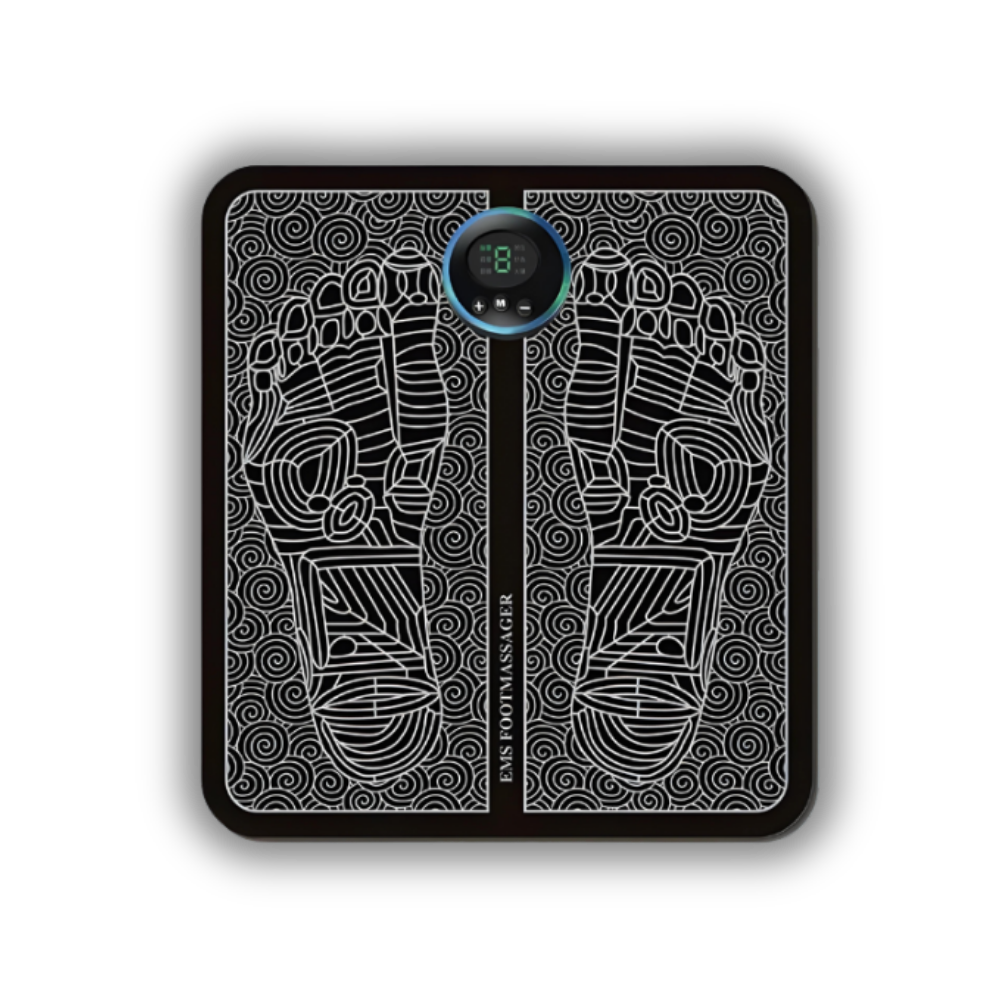
The one that worked was called Restural.
True EMS foot stimulator. Not a TENS unit. Not a vibrator. Actual electrical muscle stimulation with deep motor nerve penetration. All three requirements: deep motor neuron activation, rhythmic walking-pattern contraction cycles, and sensory feedback that travels back up to the brain.
Built on the same protocols used in neurological rehabilitation clinics. One-time purchase. Under $60.
That is what I ordered at 2am that night. That is what I shipped to my parents in Des Moines. That is what gave me my dad back.
The 90-Day Guarantee That Made Me Stop Hesitating
Here is what finally made me click "buy" at 2am that night. The guarantee.
Use Restural for 90 days. If your dad does not experience:
Noticeable reduction in freezing episodes within 2 weeks
Increased confidence at doorways and thresholds within 30 days
Your mom feeling less afraid within 60 days
...they refund every penny. No forms. No hassles.
I looked at my screen and thought: my parents have spent $47,000 on things that did not work. What is $60 with a money-back guarantee?
But here is the thing the guarantee cannot do. It cannot give you back the mobility he loses while you wait. The motor pathways going quiet right now do not care about money-back policies.
P.S. I know exactly who you are right now. You are the daughter (or the son) reading this at 11pm in an apartment hundreds of miles from your parents. You are the one your mom does not tell everything to. You are the one scrolling through Parkinson's forums when you should be sleeping because you cannot stop thinking about the last time you saw him freeze. And you feel guilty all the time. Guilty that you are not there. Guilty that your mom is exhausted. Guilty that you are angry at doctors who are "just doing their jobs." That guilt is not a flaw. That is love that does not know where to go. Order it. Ship it to their house. Fly home for a weekend and set it up yourself. Do not wait for the next appointment. Do not wait for the next dose change. You already know those are not working.
P.P.S. If his freezing has been getting worse for over two years, the window is narrowing every month. His next appointment is weeks away. The next dose adjustment will take weeks to evaluate. And it probably will not work for the freezing anyway. This arrives in days. The sooner his pathways get stimulus, the more recoverable they are. Do not wait for the system to fix what the system was never designed to fix. I waited two years. My mom waited longer. You do not have to.
P.P.P.S. I am 31 and I watched my mom turn into a full-time caregiver while my dad disappeared inch by inch. I had a conversation with my brother about assisted living in February. I was not ready. He was not ready. My mom absolutely was not ready. Eight weeks after I shipped a $60 box to their house in Des Moines, my dad walked me from the driveway to the front door without stopping. I am writing this in my kitchen in Austin at 2am because I have not stopped thinking about it for a week. If you are the one who is going to have to make this decision for your dad, for your mom, make it tonight. The Restural arrives in days. The next appointment is weeks away. Do not lose another month.
NOTICE: As of January 2026 - The demand for Restural™ EMS Device has increased dramatically and inventory has been flying off the shelves.
Lock in your order while you can to Get An Extra 40% OFF + FAST SHIPPING
Limited Time Offer Ends Sunday
Hurry! Discount ends soon.
 90 Day Money Back Guarantee
 Free & Fast Worldwide Shipping
 Safe & Secure Checkout
 No-Hassle Returns
Comments
Hannah K.
I am literally crying reading this. I am 29. My dad is 61. He was diagnosed 3 years ago. My mom is exhausted and my dad fell last week and I live 6 hours away. I just ordered one and had it shipped to their house. Flying home next weekend to set it up. Thank you for writing this.
Melissa T.
I got this for my dad two weeks ago. I am 33, he is 64. Freezing was getting worse every month and my mom was at the end of her rope. Yesterday he walked through the kitchen doorway without stopping. My mom FaceTimed me crying. It has only been two weeks but for the first time in years I feel like something is actually working on the freezing specifically. Not just the tremor. THE FREEZING.
Jessica R.
The part about the mom not wanting to "bother you at work" destroyed me. That is exactly what my mom does. I called her crying after reading this and told her she can call me anytime, day or night. She just said "I did not want to worry you." Ordering the Restural tonight. My dad is 59 with Parkinson's for 2 years. The freezing started 6 months ago.
Sam O.
How long does shipping take?? My dad's freezing is getting worse and my mom is exhausted from being his full-time carer. I want to get this to them ASAP. I am 30 and I live in Seattle, they are in Minneapolis.
Marie Campbell
Hey Sam, I got mine in just under a week. Shipped it straight to my parents' house. My dad was skeptical but my mom put it in front of his chair and told him twenty minutes. He has been using it every day since. Your parents will thank you.
Emma J.
Got this for my dad. I am 32 and he is 63. He was nervous about the pulses at first but relaxed into it after a few minutes. By day 3 he walked from the bedroom to the kitchen without a single freeze, first time in MONTHS. But what really got me was when he told my mom "I do not want to skip today." He has not been that motivated about anything in years.
Alex M.
I am 28, my dad is 60. Diagnosed 18 months ago. The freezing started 4 months ago. My mom called me in tears last week because he fell in the shower. I found this article, ordered the device, and had it at their house by Friday. It is week 3 and his freezes have dropped noticeably. My mom's voice sounds different on the phone. She sounds lighter. Thank you for writing this.
Kira D.
Bought this for my dad after his third fall in two months. His neurologist had no answers for the freezing. He has been using it every day for about 6 weeks now. The freezing episodes went from 10+ a day down to maybe 2 or 3. But the real change? My mom stopped being afraid every time he stood up. Life changing. For all of us.
Priya S.
My dad has had Parkinson's for 6 years. I am 34. I flew home last month and set this up for him myself. Just like the author. He now walks to the mailbox alone and my mom does not follow him. That is a sentence I never thought I would say. If you are the adult child wondering if you should order this, the answer is yes. Order it tonight.